Call Now (800) 879-1964
Originally published by SWR Institute Applicator Magazine, in its Winter 2026 issue: What Works: Talking Tech, Tools and ELD with Peter Brooks, President, IR Analyzers.
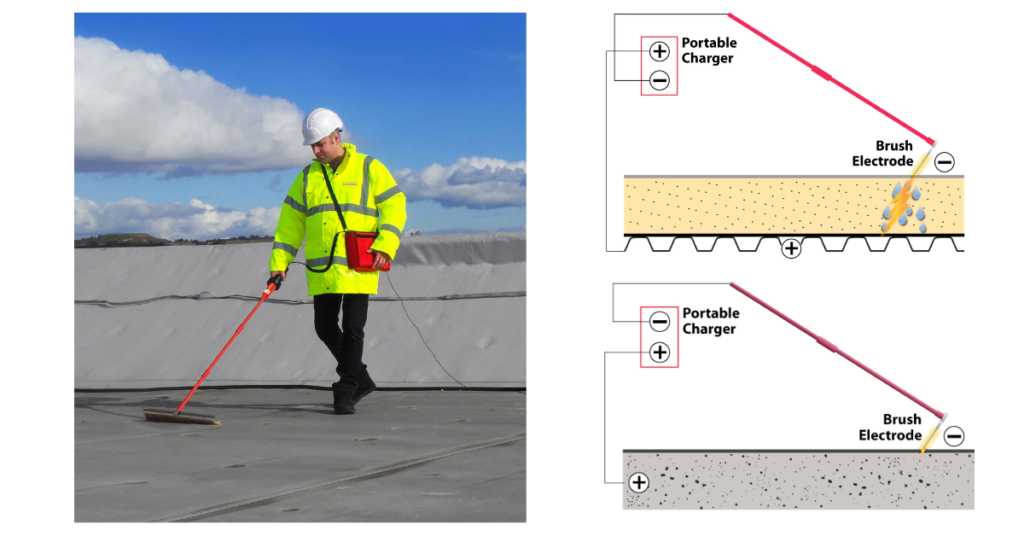
Electronic Leak Detection (ELD) has been a game-changer for our industry. It is much safer, faster, more accurate and usually less expensive than flood testing, and has become the standard integrity test procedure for newly completed waterproofing membranes. Because of its performance in the waterproofing industry, Electronic Leak Detection has also been widely adopted in conventional insulated roofing. While ELD can be hugely beneficial for virtually all roofs, successful outcomes require an understanding of how the testing procedures work, the correct applications of the techniques, and the standards that must be followed to deliver the most accurate test results.
All leak detection procedures operate on the same principle. An electrical current is introduced above the membrane. Breaches are pinpointed where the current passes through a fault and connects to a ground under the membrane. ASTM International has approved three different Electronic Leak Detection procedures in standards D7877 and D8231. However, it is critical to note that three conditions must be met to comply with these standards:
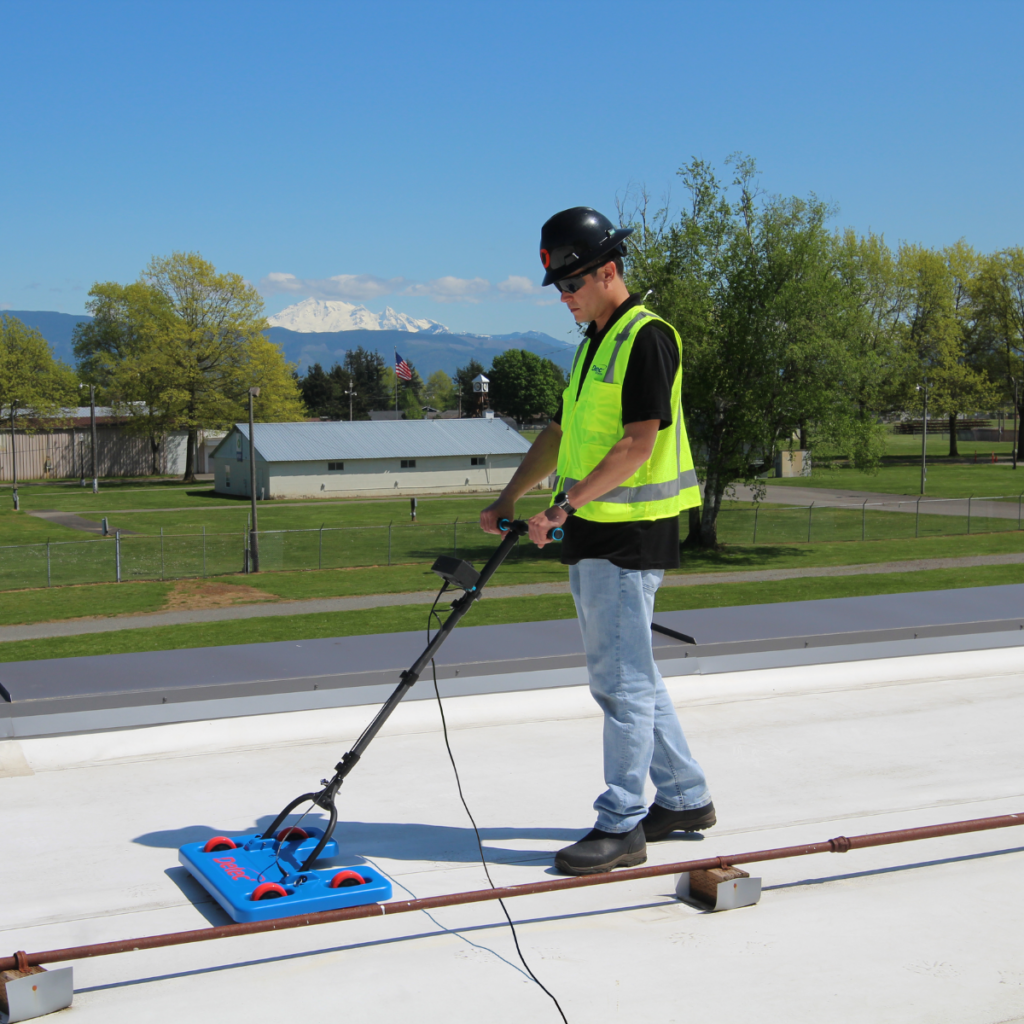
It Is vital that test providers and contractors understand and adhere to the ASTM Standards to deliver the most accurate testing possible. Compliance with the standards protects all stakeholders – manufacturers, designers and specifiers, roofing contractors, and building owners. However, adhering to the specifications is not always simple.
Testing is very straightforward with exposed IRMA roofs (Inverted Roof Membrane Assemblies). These systems meet the ASTM Standards when there is a highly conductive deck like structural concrete directly under the membrane to accept the test currents. Things get more complicated with conventional insulated roofs when coverboards and insulation are installed between the membrane and a ground like a steel or concrete deck. When dry, these materials are both thermally insulating and electrically insulating which prevents current flow to ground resulting in failure to detect breaches.
With these conventionally insulated assemblies, where the electrical path to the conductive deck is interrupted, the only way we can be sure of 100% accurate ELD testing is by “placing a conductive material directly under the membrane” [D7877 - emphasis added]. Typical alternative grounds include electrically conductive primer and conductive wire mesh.
Full disclosure is critical when the tested assembly is non-compliant, e.g. when there is no alternative ground or the alternative ground is placed beneath a non-conductive gypsum or cementitious coverboard. All stakeholders must be proactively notified that the testing does not meet the ASTM Standards, the results may not be 100% accurate and the test procedures may fail to locate breaches (testing reports false negative findings). In these situations, test providers should inform all parties that the prospects for success are limited and advise on any steps that can be taken to improve test accuracy.

Test providers must also be transparent about the obstacles to performing accurate Electric Field Vector Mapping on assemblies with overburden. The overburden may contain lightning protection systems, metal conduit, or other metal objects that create unintentional grounding which will hamper or eliminate the ability to perform an accurate test. Non-conductive materials in the assembly (root barriers, insulation, etc.) may prevent accurate interpretation of the low voltage current. The wires installed on top of the membrane to enable testing may have been displaced or damaged before placement of the overburden. In addition, the testing is performed at low voltage (40 Volts DC) and amperage. This weak electrical signal can be significantly compromised as overburden becomes thicker.
The challenges with pinpointing leaks through overburden are so great, it is critical that leak detection service providers maintain the customer’s confidence and trust by carefully managing expectations regarding the testing. All parties should be made aware that testing with overburden in place does not meet the ASTM Standards, may or may not work, and testing providers cannot guarantee that it will pinpoint breaches.
Best practices involve proactive evaluation of the system to determine the best technique(s) to fit the testing specification, weather conditions and the assembly being surveyed. It’s also hugely beneficial to have the roofing contractor on site during the inspection to address any defects so repairs can be quickly retested, and the membrane can be Certified Breach-free.
Electronic Leak Detection has become a unique asset to the industry, helping us all deliver significantly higher quality, more reliable and trouble-free assemblies. Understanding both its strengths and weaknesses will help all stakeholders utilize the value of the testing to the greatest extent possible.
Author: Peter Brooks is founder and president of IR Analyzers. He has more than 42 years of experience testing roofing systems and is a nationally recognized expert in the field of non-destructive testing. IR Analyzers provides a full range of Electronic Leak Detection and Roof Moisture Testing services nationwide.
Read the original piece, as well as the rest of SWRI Winter 2026 issue.